
Spondylolisthesis Treatment in Barry
At a Glance
Spondylolisthesis can sound worrying, especially if you have been told that one of the bones in your spine has “slipped”. In many cases, however, it is manageable. The important thing is to understand what type of spondylolisthesis you have, whether nerves are involved, and how it is affecting your movement, strength, confidence and daily life.
The key things to know
✅ Spondylolisthesis means one spinal bone has moved out of its usual position compared with the bone below. The amount of movement can be mild or more significant.
✅ It is most commonly found in the lower back, although it can occur in other areas of the spine.
✅ It is not always serious. Some people have spondylolisthesis on imaging and have very few symptoms, or no symptoms at all.
✅ Many people, especially with lower-grade spondylolisthesis, improve with conservative care such as education, activity modification, exercise rehabilitation and appropriate hands-on treatment.
✅ A good assessment can help identify whether your symptoms are mainly mechanical, nerve-related, activity-related, or whether further medical investigation may be needed.
⚠️ Seek urgent medical help if you develop new bladder or bowel changes, numbness around the saddle area, progressive leg weakness, severe trauma, fever, unexplained weight loss, or rapidly worsening symptoms.
At Highlight Osteopaths in Barry, we can assess how spondylolisthesis may be affecting your back, movement and day-to-day activities, and help you understand the most appropriate next steps.
Common Symptoms
- Lower back pain
- Pain across one side or both sides of the lower back
- Pain into the buttock
- Pain travelling into the thigh, calf or foot
- Numbness or tingling in the leg
- A heavy or tired feeling in the legs
- Tight hamstrings
- Stiffness when standing upright
- Pain with prolonged standing or walking
- Symptoms that ease when sitting or bending forward
- Pain with arching backwards
- Difficulty lifting, twisting or returning to sport
- Reduced confidence with normal movement
Some people have spondylolisthesis but no obvious symptoms. Others may have back-dominant symptoms, leg-dominant symptoms, or a mixture of both.
When Should You Seek Help?
- Your lower back pain has not settled after a few weeks
- You have pain spreading into your buttock, thigh, calf or foot
- You have numbness, tingling or weakness in one leg
- You are finding it harder to stand or walk comfortably
- Your symptoms are limiting work, sleep, exercise or normal daily life
- You have been told you have spondylolisthesis but do not understand what it means
- You are unsure which exercises are safe
- You are avoiding movement because you are worried about making the condition worse
- You have recurring episodes of back pain and want a clearer plan
- You have symptoms that are gradually worsening
NHS advice recommends seeing a GP if lower back pain or buttock/thigh pain does not improve after 3 to 4 weeks, if walking or standing upright is difficult, if you are struggling to cope, or if you have persistent leg pain, numbness or tingling.
A professional assessment can help separate common back pain patterns from symptoms that may need GP review, imaging, MSK referral or spinal specialist input.
Seek Urgent Medical Attention
Seek urgent medical attention now if you develop:
- New difficulty passing urine
- Loss of bladder or bowel control
- Numbness or altered sensation around the genitals, anus or saddle area
- New sexual dysfunction associated with back or leg symptoms
- Progressive weakness in one or both legs
- Severe back pain after a fall, accident or significant trauma
- Fever, chills or feeling very unwell with spinal pain
- Unexplained weight loss with new or worsening back pain
- A history of cancer with new unexplained spinal pain
- Severe, unrelenting or rapidly worsening symptoms
These symptoms do not mean something serious is definitely happening, but they do need urgent medical assessment because rare spinal conditions, including cauda equina syndrome, can require rapid investigation. NHS urgent back-pain guidance highlights bladder changes, saddle-area numbness, loss of bladder or bowel control, sexual-function changes and leg power loss as symptoms needing urgent help.
Spondylolisthesis
Spondylolisthesis is a spinal condition where one vertebra has shifted in relation to the vertebra below. The shift is most commonly forwards, but the important point is not just the direction of movement. What matters is the type of spondylolisthesis, the amount of movement, whether nearby nerves are affected, and how much it is influencing your daily life.
The word “slipped” is often used to describe spondylolisthesis, but it can make the condition sound more frightening than it needs to. A vertebra has not usually “slipped out” like a dislocation. Many cases are low-grade, stable and managed without surgery.
Some people only discover spondylolisthesis after an X-ray or MRI for another reason. Others develop lower back pain, buttock pain, leg symptoms, hamstring tightness, or difficulty with standing and walking.
The diagnosis alone does not tell the whole story. Pain is real, but pain and imaging findings do not always match perfectly. A scan can be useful, but it needs to be interpreted alongside your symptoms, history, examination and function.
Understanding Spondylolisthesis
What does spondylolisthesis mean?
Your spine is made of individual bones called vertebrae. These bones are connected by discs, joints, ligaments and muscles. They are designed to move, absorb load and help you adapt to daily activities such as walking, bending, lifting and changing position.
Spondylolisthesis means one vertebra has moved in relation to the vertebra below. It is commonly graded according to the percentage of slippage seen on imaging. The Meyerding system describes Grade I as up to 25%, Grade II as 26–50%, Grade III as 51–75%, Grade IV as 76–100%, and Grade V as more than 100%, also called spondyloptosis.
Lower grades are more common and are often managed conservatively. Higher grades, worsening symptoms, or clear nerve involvement may need more specialist input.
Is it the same as spondylolysis?
No. The words are similar, but they do not mean exactly the same thing.
Spondylolysis means there is a small stress fracture or defect in part of the vertebra, usually an area called the pars interarticularis.
Spondylolisthesis means one vertebra has shifted in relation to another.
Spondylolysis can sometimes lead to spondylolisthesis, especially if the stress fracture affects both sides of the vertebra. This is more common in younger people and athletes involved in repeated back extension and rotation, such as gymnastics, cricket fast bowling, diving, weightlifting, tennis or some field sports.
Spondylolisthesis can also happen without a pars stress fracture, particularly in older adults where age-related changes in the discs and spinal joints may allow one vertebra to shift relative to another.
Does the amount of movement always match the pain?
Not always.
Some people with visible spondylolisthesis have very little pain. Others with a lower-grade change may have more noticeable symptoms because of nerve sensitivity, muscle guarding, reduced movement tolerance, sleep disruption, fear of movement, or other contributing factors.
That is why good care should not simply treat the scan. It should assess the person.
Is Spondylolisthesis Serious?
Spondylolisthesis can be serious in some cases, but it is not automatically dangerous.
Many people with lower-grade spondylolisthesis live active, normal lives. Symptoms often improve with clear advice, activity modification, progressive strengthening and sensible self-management.
It becomes more concerning when there are signs of significant nerve involvement, progressive weakness, severe walking limitation, bladder or bowel changes, saddle-area numbness, severe trauma, infection signs, unexplained weight loss, or rapidly worsening symptoms.
For most people, the aim is not to panic about the position of the vertebra. The aim is to understand what your back currently tolerates, what is irritating it, what needs building up, and whether any medical referral is needed.
Common Causes of Spondylolisthesis
Age-related spinal change
Degenerative spondylolisthesis is more common in adults, especially later in life. Over time, the discs, joints and ligaments of the spine can change. In some people, this allows one vertebra to shift in relation to another.
This does not mean the spine is crumbling or broken. Age-related changes are common, and they do not always cause pain. The clinical question is whether the finding matches your symptoms and examination.
Spondylolysis or pars stress fracture
In younger people, spondylolisthesis may be linked to spondylolysis, which is a stress fracture or defect in part of the vertebra.
This is more likely in sports involving repeated lumbar extension, rotation, impact or loading. Symptoms may appear during adolescence, but some people do not notice them until adulthood.
Congenital or developmental factors
Some people are born with spinal anatomy that makes spondylolisthesis more likely. This is sometimes called dysplastic or congenital spondylolisthesis.
Symptoms may not appear until later, especially when growth, sport, work, training or other life demands change.
Trauma
A significant accident, fall or high-force injury can sometimes cause spinal movement or make an existing spondylolisthesis symptomatic.
This is less common, but important if symptoms start after clear trauma.
Pathological causes
Rarely, spondylolisthesis can be linked to bone disease, infection, tumour or other conditions that weaken the vertebra.
This is one reason why symptoms such as fever, unexplained weight loss, history of cancer, night sweats, severe unrelenting pain or feeling very unwell should be taken seriously.
Previous spinal surgery
Some people develop altered loading at spinal levels near a previous operation. This does not mean surgery has failed, but previous surgery can change how the surrounding spine tolerates load.
Risk Factors for Spondylolisthesis
Risk factors can include:
- Older age
- Being female, particularly for degenerative spondylolisthesis
- Family history of spondylolysis or spondylolisthesis
- Repeated back extension sports
- Gymnastics, diving, cricket fast bowling, tennis, weightlifting or some contact sports
- Previous pars stress fracture
- Age-related changes in the discs and spinal joints
- Sudden increases in training load
- Jobs involving repeated lifting or prolonged standing
- Previous spinal injury
- Previous spinal surgery
- Higher body weight in some degenerative cases
Having a risk factor does not mean you will definitely develop symptoms. It simply means spondylolisthesis may be more likely, or more relevant, when symptoms appear.
Why can it cause lower back pain?
Spondylolisthesis may change how load passes through one part of the lower back. This can irritate nearby joints, muscles, ligaments or discs.
Pain may feel central, one-sided, band-like, deep, sharp, dull, stiff or aching.
Some people notice pain with standing, walking, arching backwards, lifting or twisting. Others notice symptoms after sport, gardening, DIY, prolonged standing, or getting up from a chair.
Why can symptoms go into the leg?
In some cases, spondylolisthesis can narrow the space around a spinal nerve. This may contribute to symptoms into the buttock, thigh, calf or foot.
- Leg symptoms can include:
- Pain
- Aching
- Burning
- Pins and needles
- Numbness
- A heavy feeling
- Weakness
- Cramp-like symptoms
This may feel similar to sciatica. However, not all leg pain comes from the spine. Hip problems, knee problems, muscle sensitivity, vascular issues and other conditions can also cause leg symptoms, so assessment matters.
Why can standing and walking feel worse?
Some people with spondylolisthesis develop a pattern where standing and walking bring on back or leg symptoms, while sitting or bending forward gives relief.
This can happen when the space around the nerves becomes more sensitive in upright or extended positions. Sitting or leaning forward may temporarily give the irritated area more room, which is why some people feel better leaning on a shopping trolley or sitting down.
This pattern overlaps with lumbar spinal stenosis, which is why clinical assessment should consider both.
Why can hamstrings feel tight?
Hamstring tightness is commonly reported with spondylolisthesis, especially in younger people or more extension-sensitive presentations.
This does not always mean the hamstrings are the cause of the problem. They may be reacting to sensitivity around the lower back, pelvis or nervous system.
Stretching may help some people, but it should not be forced aggressively if it increases symptoms.
Why can movement feel frightening?
Being told that a bone has shifted can make people worry that normal movement will cause more slipping.
That fear is understandable, but it can sometimes lead to unnecessary avoidance. Avoiding everything may reduce confidence, strength and fitness over time.
The goal is usually not complete protection forever. It is graded exposure: understanding what is currently sensitive, modifying what is too provocative, and gradually rebuilding strength and tolerance.
Diagnosis
Spondylolisthesis is diagnosed using a combination of history, physical examination and imaging when appropriate.
Case history
A clinician may ask about:
- Where your pain is
- How long symptoms have been present
- Whether symptoms started suddenly or gradually
- Whether symptoms travel into the leg
- What makes symptoms better or worse
- Whether standing or walking is limited
- Whether sitting or bending forward helps
- Any numbness, tingling or weakness
- Any bladder, bowel or saddle-area symptoms
- Previous injury, sport, surgery or imaging
- Work, activity and exercise demands
- General health and red flags
Physical examination
Assessment may include:
- Spinal movement
- Hip movement
- Neurological screening
- Reflexes
- Sensation
- Muscle strength
- Straight leg raise or nerve-related testing
- Walking and standing tolerance
- Functional movements such as squatting, bending or single-leg control
- Palpation of relevant muscles and spinal areas
The examination helps identify whether symptoms appear mechanical, nerve-related, inflammatory, traumatic, or potentially linked to another cause.
Imaging
X-rays can show the position of one vertebra in relation to another and can help grade the amount of slippage.
MRI may be useful if there are leg symptoms, numbness, weakness, suspected nerve involvement, or if symptoms are not following an expected pattern.
CT can show bony detail clearly, especially where a pars defect is suspected, but the choice of imaging depends on the clinical situation and medical referral pathway.
Imaging is useful, but it is not the whole answer. Scan findings need to be matched with symptoms, examination and function.
In most cases, no.
Many people understandably assume a scan will reveal exactly what’s causing their pain.
In reality, MRI scans frequently show changes that are completely normal and become more common as we age.
Research has shown that many people without any back pain have findings such as:
- Disc bulges.
- Disc degeneration.
- Facet joint arthritis.
- Disc height loss.
These changes are often part of normal ageing rather than the cause of symptoms.
For this reason, NHS and NICE guidance generally recommends avoiding routine imaging for uncomplicated lower back pain unless there are signs suggesting a more serious condition or imaging is likely to change management.
If, during your assessment at Highlight Osteopaths, I feel further investigation would be appropriate, I’ll explain exactly why and help guide you towards the most appropriate next step, whether that’s your GP, imaging or another healthcare professional.
Treatment Options
Treatment depends on the type and grade of spondylolisthesis, whether nerves are involved, how severe symptoms are, and how much it is affecting daily life.
Education and reassurance
Understanding the condition often reduces fear.
A helpful explanation should make clear that spondylolisthesis does not always mean danger, permanent damage or inevitable surgery.
Activity modification
This means temporarily adjusting the activities that clearly aggravate symptoms.
It may include reducing:
- Repeated deep back extension
- Heavy lifting during a flare-up
- High-impact sport
- Long periods of standing
- Long walks that consistently trigger leg symptoms
- Repeated twisting under load
The aim is not permanent avoidance. The aim is to calm symptoms, then gradually rebuild tolerance.
Exercise rehabilitation
Exercise is usually central to conservative management.
A programme may include:
- Trunk control
- Hip strength
- Glute strength
- Lower-limb strength
- Balance
- Walking tolerance
- Gentle mobility
- Hamstring and hip-flexor flexibility where appropriate
- Gradual return to lifting, work or sport
The best plan depends on the person. A teenager with extension-related pain from sport may need a different approach from an older adult with walking-related leg symptoms.
Manual therapy
Manual therapy may help some people as part of a broader package of care.
NICE guidance for low back pain and sciatica recommends considering manual therapy, such as spinal manipulation, mobilisation or soft tissue techniques as part of a treatment package that includes exercise, with or without psychological therapy.
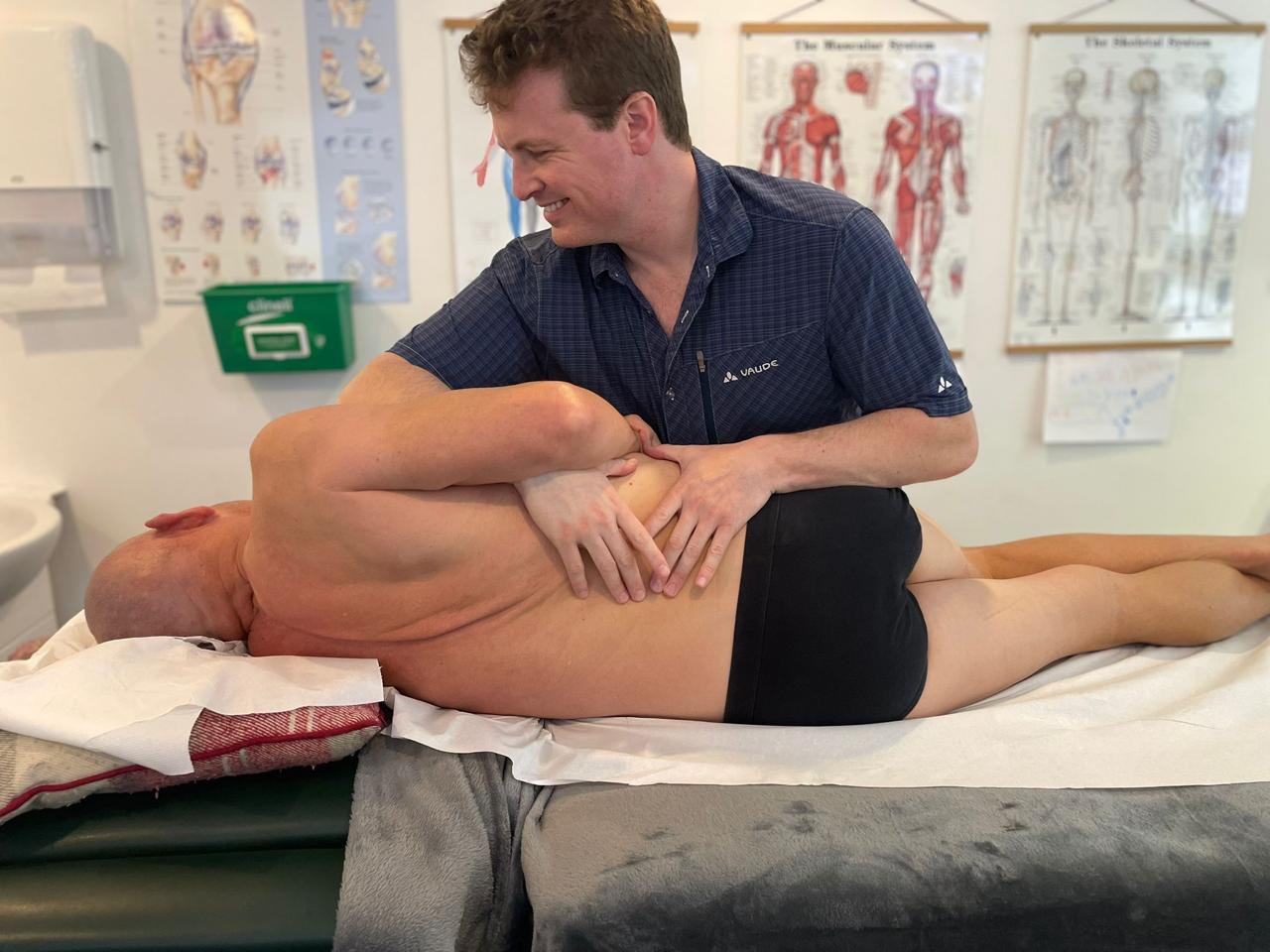
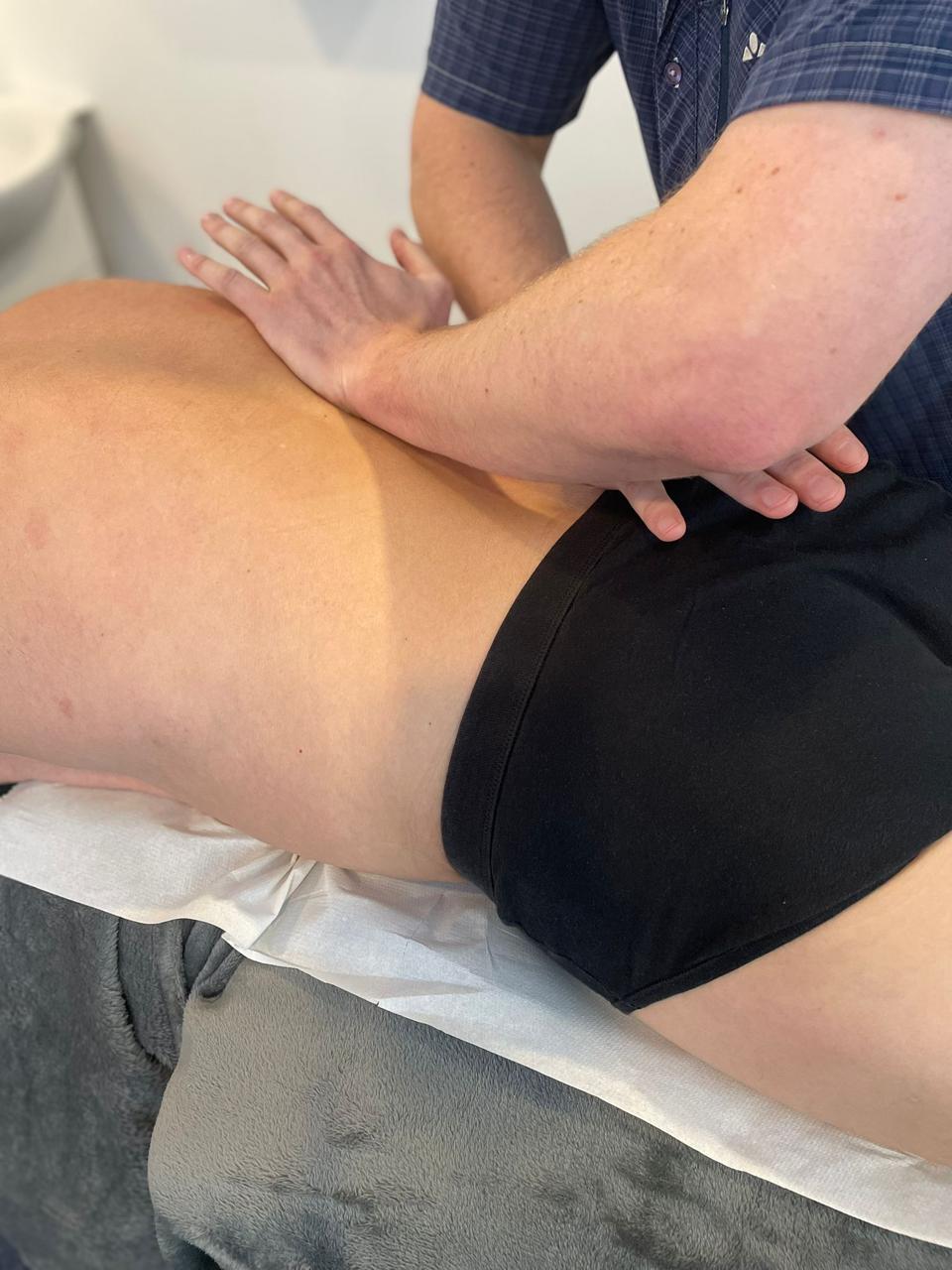
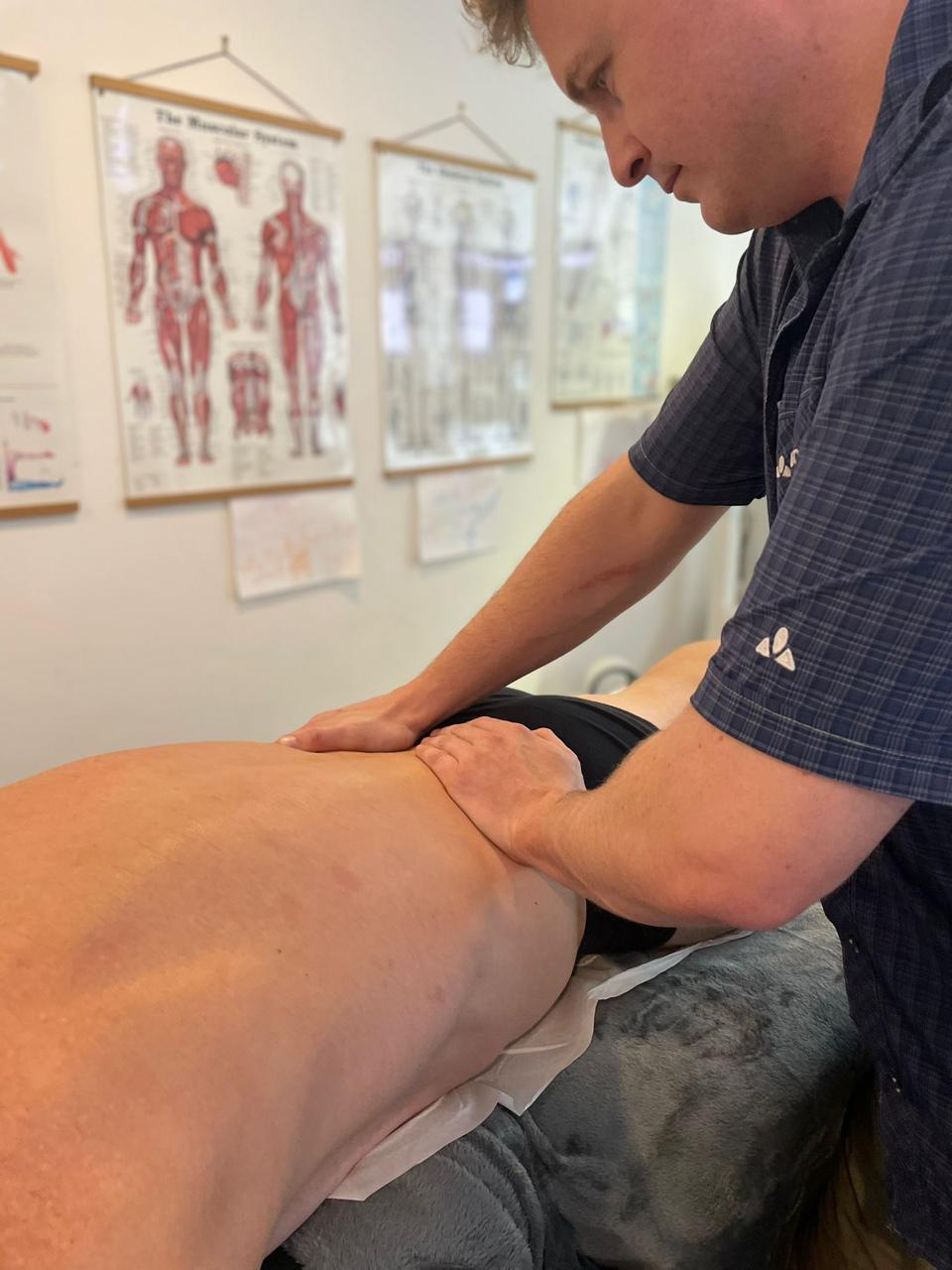
For spondylolisthesis, manual therapy should not be presented as putting a vertebra back in place. It may be used to help reduce pain, ease protective muscle tension, improve movement in related areas, and make rehabilitation more tolerable.
Medication
Some people use pain relief or anti-inflammatory medication during a flare-up. This should be discussed with a GP or pharmacist, especially if you have other health conditions, take other medication, or have stomach, kidney, heart or blood-pressure concerns.
Medication may help symptoms, but it does not replace assessment, movement advice or rehabilitation.
Injections
In some cases, spinal injections may be considered by a specialist, particularly when leg pain is severe and nerve irritation is suspected.
Injections are not usually the first step for simple lower back pain, and they should be considered in the context of symptoms, imaging and overall management.
Surgery
Surgery is not needed for everyone with spondylolisthesis.
It may be considered when symptoms are severe, progressive, significantly limiting, linked with neurological compromise, or not improving with appropriate conservative care.
Surgical options may include decompression, fusion, or a combination of procedures depending on the individual case. This decision should be made with a spinal specialist after careful discussion of symptoms, imaging, risks, benefits and realistic goals.
How Osteopathy May Help
Osteopathy does not “put the vertebra back in place”, “reverse the slip”, or “realign the spine”.
Osteopathy may help by assessing contributing factors, improving movement where appropriate, reducing pain, guiding rehabilitation and identifying when referral may be needed.
At Highlight Osteopaths, assessment may consider:
- How your lower back is moving
- Whether your symptoms suggest nerve irritation
- How your hips, pelvis and thoracic spine are contributing to load
- Your walking, standing and lifting tolerance
- Strength and control around the trunk and hips
- Movements that calm or aggravate symptoms
- Whether symptoms need GP, MSK, imaging or specialist referral
- Treatment may include:
- Gentle manual therapy
- Soft tissue techniques
- Joint mobilisation where appropriate
- Advice on positions that ease symptoms
- Exercise progression
- Load-management advice
- Walking and activity planning
- Education about scan findings
- Clear guidance on when to seek medical review
The goal is not to force the spine into a different position. The goal is to help you understand your symptoms, move with more confidence, improve function and build a realistic plan for recovery.
Self-Management
Keep moving, but respect irritability
Complete rest is rarely the best long-term answer for most back pain. Try to keep moving within a tolerable range.
If symptoms are irritable, reduce the most provocative activities for a short period while keeping gentle movement going.
Use positions that calm symptoms
Some people feel better with slight flexion, such as sitting, leaning forward, lying with knees supported, or resting in a position that reduces leg symptoms.
These positions do not “fix” the spondylolisthesis, but they can help settle sensitivity during a flare-up.
Build walking tolerance gradually
If walking brings on symptoms, start with shorter, more frequent walks rather than forcing one long walk.
For example, someone in Barry might begin with short, flat walks and gradually build tolerance along Barry Island promenade, around Knap Gardens, or at Cosmeston Lakes.
Strengthen progressively
A rehabilitation plan may include:
- Pelvic tilts
- Dead bugs
- Glute bridges
- Side planks
- Bird dogs
- Hip hinges
- Step-ups
- Loaded carries
- Walking intervals
- Balance work
The right exercise depends on the person, the stage of symptoms and the goal. Exercises should usually feel tolerable and should not cause a clear flare-up that lasts into the next day.
Be cautious with aggressive stretching
Hamstring or hip-flexor stretching may help some people, but aggressive stretching can irritate symptoms in others.
A useful rule is to work gently and avoid forcing positions that clearly reproduce back or leg pain.
Modify extension-sensitive activities
If arching backwards aggravates your symptoms, it may help to temporarily reduce repeated extension-based activities.
This might include certain gym movements, gymnastics, fast bowling, tennis serving, prolonged standing postures, or heavy overhead lifting.
This does not mean you must avoid these activities forever. It means they may need to be reintroduced gradually.
Do not let fear make the world smaller
It is understandable to feel cautious after a diagnosis. But if fear leads to avoiding most movement, strength and confidence can reduce.
A good plan should help you know what to avoid for now, what to keep doing, and what to rebuild.
Recovery
Recovery varies from person to person.
Some people improve within weeks with clear advice, activity modification and appropriate exercises. Others need a longer rehabilitation plan, especially if symptoms have been present for months or years, if there is nerve involvement, or if walking tolerance is reduced.
A good outcome does not always mean the spondylolisthesis disappears on imaging. It often means:
- Pain reduces
- Leg symptoms settle
- Walking becomes easier
- Strength improves
- Confidence returns
- Flare-ups become easier to manage
- Work, sport or hobbies become more achievable
Many people can remain active with spondylolisthesis when they have a clear, realistic plan.
Common Myths About Spondylolisthesis
“A slipped vertebra means my spine is unstable.”
Not necessarily. Many lower-grade cases are stable and manageable. The word “slipped” can sound frightening, but the spine is still supported by discs, joints, ligaments and muscles.
“The vertebra needs to be put back in place.”
This is not how conservative care works. Osteopathy, physiotherapy or chiropractic treatment should not claim to push the vertebra back. The aim is to reduce symptoms, improve movement, guide rehabilitation and identify when referral is needed.
“If it shows on a scan, it must be the cause of all my pain.”
Not always. Imaging can be useful, but scan findings need to match your symptoms, examination and function.
“I should avoid all exercise.”
Avoiding everything can reduce strength, confidence and fitness. The better approach is usually to modify painful activities, then gradually rebuild movement, strength and tolerance.
“Pain means the slip is getting worse.”
Pain can increase for many reasons, including sensitivity, muscle guarding, activity spikes, poor sleep, stress, nerve irritation or changes in load. Worsening symptoms should be assessed, but pain does not automatically mean the vertebra has moved further.
“Spondylolisthesis always needs surgery.”
No. Many people improve with conservative care. Surgery is usually considered when symptoms are severe, progressive, linked with neurological compromise, or not responding to appropriate non-surgical management.
“Core exercises are the only answer.”
Core exercises can be useful, but rehabilitation should be broader than that. Hip strength, leg strength, walking tolerance, balance, mobility, pacing and confidence all matter.
Frequently Asked Questions About Spondylolisthesis
Answers to some of the most common questions about spondylolisthesis and osteopathic treatment.
What is spondylolisthesis?
Spondylolisthesis means one vertebra has shifted in relation to the vertebra below. The movement is most commonly forwards, but the amount can range from mild to more significant.
Is spondylolisthesis serious?
It can be serious in some cases, but many lower-grade cases are manageable without surgery. It is more concerning if there is progressive weakness, severe nerve pain, bladder or bowel changes, saddle numbness, trauma, infection signs, unexplained weight loss or rapidly worsening symptoms.
Can spondylolisthesis improve?
Symptoms can often improve, even if the imaging appearance does not fully change. Recovery usually focuses on reducing pain, improving movement, building strength and increasing confidence with daily activity.
Can spondylolisthesis cause sciatica?
Yes. If the change narrows the space around a spinal nerve, it may contribute to sciatica-type symptoms such as buttock pain, leg pain, numbness, tingling or weakness.
Does spondylolisthesis always need surgery?
No. Many people manage well with conservative care. Surgery may be considered if symptoms are severe, progressive, disabling, or not improving with appropriate non-surgical treatment.
Is walking good for spondylolisthesis?
Walking can be helpful if it is tolerated. Some people need to begin with shorter walks and gradually build up. If walking consistently causes leg pain, heaviness, numbness or weakness, assessment is recommended.
What exercises should I avoid with spondylolisthesis?
This depends on your symptoms. During a flare-up, repeated heavy lifting, deep back extension, high-impact activity or painful twisting may need to be reduced. The long-term goal is usually graded return, not permanent avoidance of all movement.
Can an osteopath help with spondylolisthesis?
An osteopath may help by assessing your symptoms, movement, nerve function and contributing factors. Treatment may include manual therapy, exercise advice, rehabilitation and referral guidance where needed. Osteopathy does not put the vertebra back in place.
Should I get an MRI?
Not everyone with spondylolisthesis needs an MRI. MRI may be more relevant if there are leg symptoms, numbness, weakness, severe or persistent symptoms, or if the result would change management.
Can spondylolisthesis get worse with age?
Some age-related spinal changes can progress over time, but symptoms do not always worsen. Many people remain active and manage well with strength, movement, pacing and appropriate care.
Is spondylolisthesis the same as spondylolysis?
No. Spondylolysis is a stress fracture or defect in part of the vertebra. Spondylolisthesis is when one vertebra has shifted in relation to another. Spondylolysis can sometimes lead to spondylolisthesis.
Can children or teenagers get spondylolisthesis?
Yes. In younger people, it is often linked to a pars stress fracture and sports involving repeated extension, rotation or impact. Persistent back pain in a young athlete should be assessed properly.
Can I still lift weights with spondylolisthesis?
Possibly, but it depends on your symptoms, grade, strength, technique and irritability. During a flare-up, heavy lifting may need to be reduced. Longer term, many people benefit from graded strengthening with appropriate guidance.
Why Choose Highlight Osteopaths For Spondylolisthesis Treatment?
At Highlight Osteopaths in Barry, we focus on clear explanations, careful assessment and realistic treatment plans.
With spondylolisthesis, the goal is not to frighten you with scan findings or make unrealistic promises. The goal is to help you understand what is happening, identify what may be driving your symptoms, and build a plan that fits your life.
We can help assess:
- Whether symptoms appear mechanical or nerve-related
- Which movements are aggravating or relieving symptoms
- Whether your hips, pelvis, back or walking pattern are contributing
- What exercises may be appropriate
- Whether you need GP, MSK, imaging or specialist referral
- How to return to normal activity safely and confidently
We support people from Barry, the Vale of Glamorgan, Cardiff and across South Wales with back pain, sciatica and movement-related problems.
Book an Appointment
If you have been told you have spondylolisthesis, or you have lower back pain with buttock or leg symptoms, a clear assessment can help you understand what is going on and what to do next.
Book an appointment with Highlight Osteopaths in Barry for practical, evidence-informed support with back pain, movement and rehabilitation.
Ready to get started?
Whether you're struggling with a recent injury or pain that's been bothering you for months, I'm here to help.
Book your appointment online today and let's work together to understand your pain and get you moving with confidence again.
Conditions I commonly treat

Reach Out and Chat
Location
31 Lakin Drive,
Barry,
CF62 8AH